

Fifty Is the New Seventeen: The Rise of Middle-Aged Protagonists

Kendog
Growing old terrifies me. The thinning hair, the deepening wrinkles, the gut spilling over my belt. For as long as I can remember, I’ve carried this vague, nagging dread of aging—and ‘shonen’ manga, with its hot-blooded teenagers tearing across the page, has always been my escape hatch.
In manga, young heroes shout their dreams to the sky, slam into walls, cry and laugh alongside their friends, and grow stronger for it. Just dipping into that familiar formula was enough to trick me into feeling like I, too, had grabbed hold of eternal youth.
Lately, though, a slightly different current has been running through the Japanese manga scene. Series built around worn-out, middle-aged guys as their leads have been quietly but steadily gaining ground.
In Japan, there’s a word for this kind of character: ‘ike-oji’. It’s a mashup of ‘iketeru (cool, attractive)’ and ‘ojisan (older guy)’—a term for the type of man whose appeal comes not from youth or raw energy, but from experience and composure.
So today, I’d like to introduce four protagonists who each embody the ikéoji archetype in their own way. Think vintage denim, think aged wine—the kind of appeal that only comes from having a few years on the clock. Enjoy.
1. SAKAMOTO DAYS — The Quiet Retirement of a Living Legend
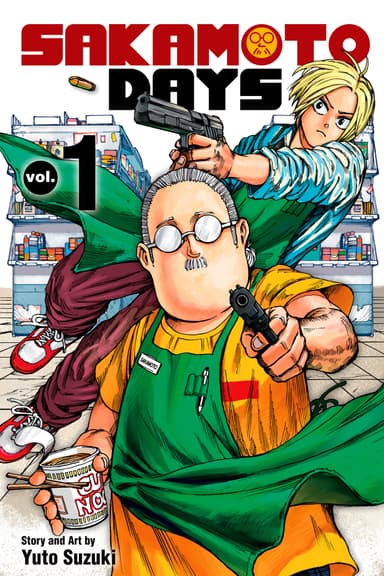
A man once hailed as the deadliest assassin in the underworld now runs a small-town convenience store with his wife and daughter. Taro Sakamoto, 30-something, overweight. Today he’s checking the potato chip inventory while dispatching a would-be killer between the shelves.
If I had to sum up this series in a single image, it would be Colonel Sanders starring in John Wick. Adapted into an anime in 2025 and surpassing 15 million copies in circulation (as of August 2025), Sakamoto Days lulls you with its laid-back, slice-of-life vibe—then shatters it without warning by dropping in explosive action sequences. The way the story keeps swinging between calm and chaos, like a roller coaster that never lets you catch your breath, just feels good.
The setup of “a professional of violence fighting to protect an ordinary life” also runs through Shimazaki in the Land of Peace (Heiwa no Kuni no Shimazaki e), the story of a former terrorist operative trying to settle back into normal life in Japan. For middle-aged men like me—guys who have somehow faded into the background of society without noticing—both protagonists offer a fantasy: a version of ourselves that has rediscovered its old edge.
2. From Old Country Bumpkin to Master Swordsman — The Man Who Doesn’t Know His Own Strength

In today’s fantasy manga landscape, where the isekai genre reigns supreme, the “secretly the strongest all along” protagonist is practically a standard-issue character template. Usually, the hero leverages hidden power to claw their way up from the bottom. This series takes a different route. It’s about a man who has already let go of any desire to prove his strength.
Beryl is an unassuming, aging swordsmanship instructor running a modest dojo in the middle of nowhere. Then his former students start showing up one after another—and it turns out every single one of them has gone on to achieve extraordinary things. Despite their sky-high estimation of him, Beryl himself remains completely oblivious to his own abilities, humble to a fault. But the moment he draws his blade, that power speaks for itself, and he gradually earns an unshakable reputation across the kingdom.
The particular charm of this manga lies in the warmth and gentle comedy of a man whose work should have been long finished, yet who finds himself still needed. There’s plenty of the spectacle you’d expect from a fantasy setting, but the aftertaste is closer to comfort food. If the anime’s blend of swordsmanship and heart drew you in, the manga is where you can savor that understated, silver-fox appeal at your own pace.
3. Smoking Behind the Supermarket with You — A Cigarette Break’s Worth of Closeness
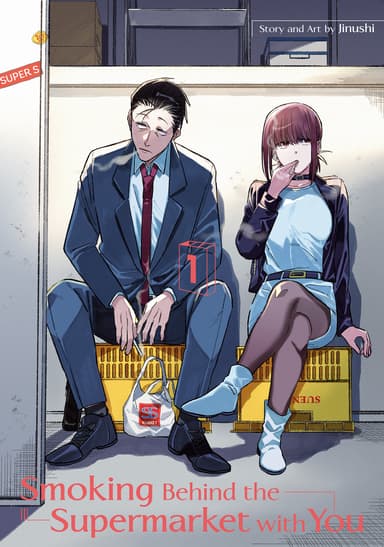
A rural supermarket. A narrow corridor out back, for employees only. Every day at the same time, Sasaki—a worn-down, 40-something corporate drone—stands side by side with Yamada (Tayama), a young woman who works at the store, and they smoke. That’s it.
There’s a faint hint of something romantic hovering around them, but it just kind of hangs in the air like cigarette smoke—and basically, nothing happens. The two of them simply chat about nothing in particular while they smoke.
As a fellow middle-aged guy, I feel Sasaki’s habit of swinging by the back of the supermarket after work, looking for someone to talk to, right in my chest. Having someone who’ll just listen is an almost unreasonable comfort for a man of a certain age. And as it turns out, for Yamada, Sasaki—this guy who talks to a younger woman without any ulterior motive—is apparently kind of… cute.
The anime adaptation aired in summer 2026, but if you really want to appreciate the full charm of a middle-aged man with failing eyesight blushing like a schoolboy—those bashful, almost adolescent reactions rendered in loving detail—do yourself a favor and check out the original manga.
4. Inuyashiki — Grandpa Is a Living Weapon

Ichiro Inuyashiki, the protagonist, is 58 years old. An unremarkable office worker, dismissed by his own family, he’s just been told he has cancer. Three months to live. By the opening pages, his life has quietly reached a dead end.
Then something that can only be described as science fiction intervenes. A mysterious explosion destroys Inuyashiki’s body, and extraterrestrial beings reconstruct him—leaving him to carry on as a humanoid robot, his memories from before the accident fully intact.
As fate would have it, a teenager named Hiro Shishigami is “rebuilt” in the same accident.
But where the boy gradually loses all resistance to hurting people as his new power grows, Inuyashiki finds his reason for existing in saving the lives of complete strangers. Through this contrast between the aging hero and the young god of destruction, a peculiar kind of absurdity and sadness rises to the surface—the emotional weight that comes with wielding superhuman power.
The creator, Hiroya Oku, made his name with GANTZ, known for its meticulously detailed mechanical art and dynamic battle sequences. In Inuyashiki, that same visceral draftsmanship meets a new motif—the aging body—and the combination produces something entirely its own.
The Space “Middle Age” Occupies in Manga
The four protagonists featured here each carry a distinct brand of appeal, and distilling them into a single vision of the ikéoji might be a tall order. But if there’s one thread running through all of them, it’s this: a quiet, understated assertion from adults who have burned off the flashy ambition of youth.
Wrinkles deepen and waistlines expand for everyone eventually. Rather than chasing the fantasy of eternal youth, we’re probably better off finding cool older role models to look up to. These protagonists, I think, aren’t just new templates for middle-aged readers like me—they might also ease, for younger readers, the fear of what getting older actually looks like.
About the Author
kendog

41 years old, married with kids. Quietly shedding tears over romance manga while his daughters lose their minds over shonen.